ZELENSKY nos Pandora papers_ MARIN _ 24 Mar 22 _ RASCUNHO
ZELENSKY nos Pandora papers _Rascunho _ MARIN _ 24 Mar 22 _ RASCUNHO


07/03/2022 às 08h52min - Atualizada em 07/03/2022 às 08h52min
Pandora Papers: Zelensky roubou dinheiro público para financiar sua ascensão ao poder
A ascensão do presidente fantoche ucraniano Volodymyr Zelensky ao poder foi financiada por dinheiro público roubado canalizado para ele por oligarcas corruptos, de acordo com documentos vazados.
Open4business.com

Como a guerra da Ucrânia está sendo orquestrada para implementar 'a grande reinicialização'
Os documentos mostram que Zelensky e seus sócios em uma produtora de televisão, a Kvartal 95, montaram uma rede de empresas offshore que remonta pelo menos a 2012, ano em que a empresa começou a fazer conteúdo regular para emissoras de TV pertencentes a Ihor Kolomoisky, um oligarca perseguido por alegações de fraude multibilionária. Os offshores também foram usados pelos associados de Zelensky para comprar e possuir três propriedades privilegiadas no centro de Londres.
Zelensky aproveitou a raiva generalizada do público contra a corrupção, mas sua campanha de 2019 foi marcada por dúvidas sobre sua boa fé anticorrupção, já que sua campanha foi impulsionada pela mídia pertencente a Kolomoisky – que é acusado de roubar US$ 5,5 bilhões de seu próprio banco e canalizando-o para o exterior em conjunto com seu parceiro, Hennadiy Boholiubov.
Durante a campanha, o parlamentar pró-Poroshenko Ariev alegou que Zelensky e seus parceiros eram beneficiários de uma rede offshore de empresas que recebeu US$ 41 milhões em pagamentos provenientes do Privatbank, a instituição financeira ucraniana que o oligarca Kolomoisky teria saqueado.
Relatórios do Open4business.com : Informações sobre mais de 1.500 ucranianos, incluindo o presidente Volodymyr Zelensky e seus colegas de trabalhos anteriores, o ministro da Cultura Oleksandr Tkachenko, os empresários Oleksandr Yaroslavsky, Ihor Voronin e Rinat Akhmetov, ex-proprietários do PrivatBank Ihor Kolomoisky e Hennadiy Boholiubov, MP Oleksandr Hereha é mencionado no novo vazamento global de documentos offshore da Pandora Papers, disse a publicação Slidstvo.Info.
“Também havia oligarcas ucranianos, ex-funcionários e atuais, deputados e até estrelas do esporte e pop nos documentos. No total, há mais de 1.500 ucranianos em Pandora Papers”, disse Slidstvo.Info, que junto com mais de 600 jornalistas de 117 países do mundo, membros do Consórcio Internacional de Jornalistas Investigativos (ICIJ), trabalhou no projeto Pandora Papers.
De acordo com os dados, em particular, as empresas offshore de Zelensky e sua equipe teriam recebido US$ 40 milhões de empresas offshore associadas a Kolomoisky desde 2012, quando o estúdio Kvartal 95 começou a cooperar com o canal de televisão 1 + 1 do empresário. “Juntamente com Zelensky, o chefe do Serviço de Segurança do Estado da Ucrânia, Ivan Bakanov, bem como o primeiro assistente do presidente Serhiy Shefir, aparecem nos jornais offshore”, disseram os investigadores.
É indicado que antes de ser eleito presidente em 2019, Zelensky transferiu sua participação na empresa offshore para Shefir.
 Pandora papers Volodymyr ZelenskiyTopics
Revealed: ‘anti-oligarch’ Ukrainian president’s offshore connections
Volodymyr Zelenskiy has railed against politicians hiding wealth offshore but failed to disclose links to BVI firm

It was a storyline that in earlier times would have seemed impossible. For four years, the actor and comedian Volodymyr Zelenskiy entertained TV audiences in Ukraine with his starring role in the sitcom Servant of the People. Zelenskiy played a teacher who, outraged by his country’s chronic corruption, successfully runs for president. In 2019, Zelenskiy made fiction real when he contested Ukraine’s actual presidential election and won.
On the campaign trail, Zelenskiy pledged to clean up Ukraine’s oligarch-dominated ruling system. And he railed against politicians such as the wealthy incumbent Petro Poroshenko who hid their assets offshore. The message worked. Zelenskiy won 73% of the vote and now sits in a cavernous office in the capital, Kyiv, decorated with gilded stucco ceilings. Last month, he held talks with Joe Biden in the Oval Office.
The Pandora papers, leaked to the International Consortium of Investigative Journalists (ICIJ) and shared with the Guardian as part of a global investigation however, suggest Zelenskiy is rather similar to his predecessors.
The leaked documents suggest he had – or has – a previously undisclosed stake in an offshore company, which he appears to have secretly transferred to a friend weeks before winning the presidential vote.
Quick GuideWhat are the Pandora papers?
Show
Zelenskiy has not commented on the claim despite extensive attempts by the Guardian and its media partners to reach him. His spokesperson Sergiy Nikiforov messaged: “Won’t be an answer.”
The files reveal Zelenskiy participated in a sprawling network of offshore companies, co-owned with his longtime friends and TV business partners. They include Serhiy Shefir, who produced Zelensky’s hit shows, and Shefir’s older brother, Borys, who wrote the scripts. Another member of the consortium is Ivan Bakanov, a childhood friend. Bakanov was general director of Zelenskiy’s production studio, Kvartal 95.
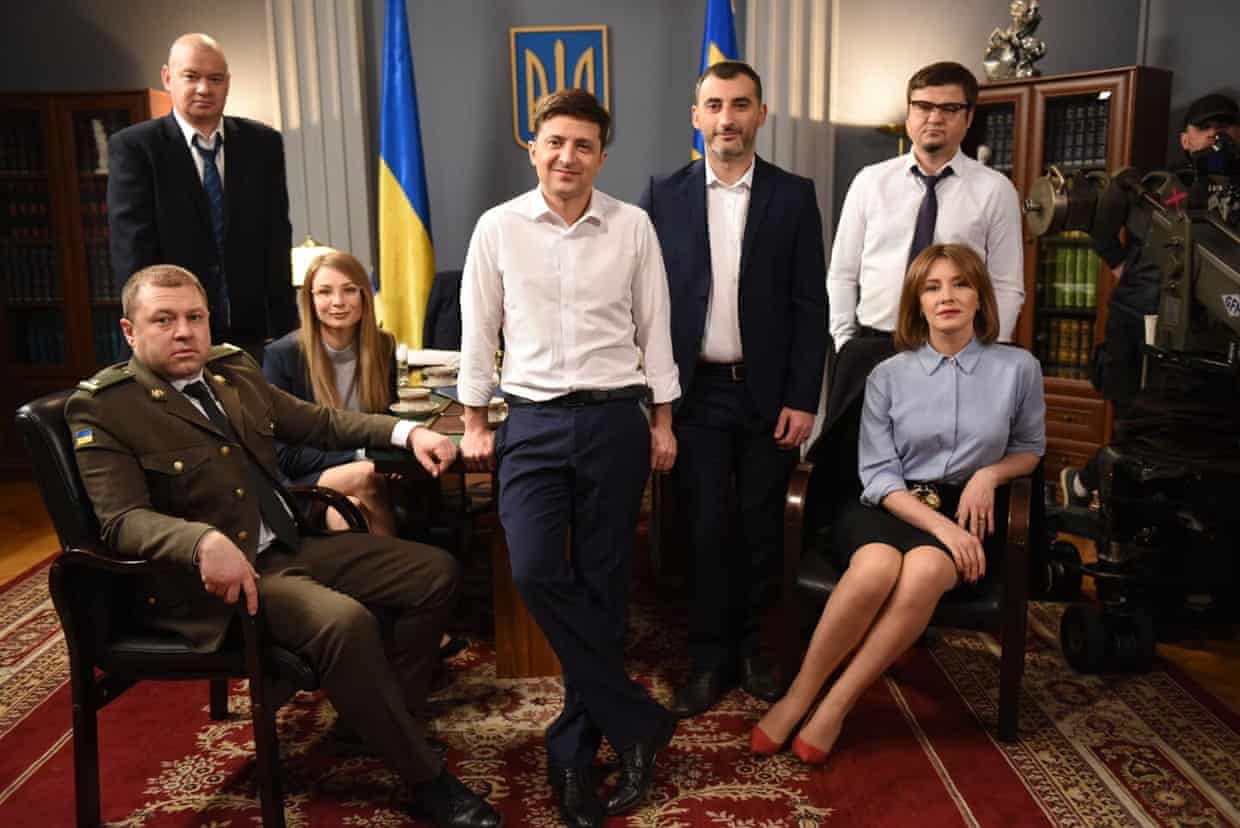
All are associated with Zelenskiy’s home town in southern Ukraine, Kryvyi Rih. After winning power, Zelenskiy brought these close allies into government. Bakanov became head of Ukraine’s SBU security agency. Zelenskiy made Serhiy Shefir his first assistant, an unpaid role that involves handling the president’s daily schedule. A fourth member of this close-knit group, Andriy Yakovlev, is a film director and Kvartal 95 producer.
Zelenskiy has said these appointments were about personal trust rather than financial cronyism. “I have a few people who work with me who have been my friends for a long time … They have no relation to business, or to the budget,” he told the Guardian in 2020.
A secret transfer
Before becoming president, Zelenskiy declared some of his private assets. They included cars, property and three of the co-owned offshore companies. One, Film Heritage, which he held jointly with his wife, Olena, a former Kvartal 95 writer, is registered in Belize.
But the Pandora papers show further offshore assets that Zelenskiy appears not to have revealed. Film Heritage had a 25% stake in Davegra, a Cyprus holding company. Davegra in turn owns Maltex Multicapital Corp, a previously unknown entity registered in the tax haven of the British Virgin Islands (BVI). Zelenskiy, the Shefir brothers, and Yakovlev each held a 25% stake in Maltex.
On 13 March 2019, two weeks before the first round of voting in Ukraine’s election, Zelenskiy gave his quarter stake in Maltex to Serhiy Shefir, documents show. It is unclear if Shefir paid Zelenskiy. Bakanov witnessed this secret transfer and signed the offshore papers.

Roughly six weeks later, after Zelenskiy’s landslide victory, a lawyer acting for the Kvartal 95 group signed another document. It stipulated that Maltex would continue to pay dividends to Zelenskiy’s Film Heritage, even though it no longer owned any stake in the company. Its main revenue comes from activity in Ukraine, Russia and Belarus, according to a Maltex client profile.
The Pandora papers do not indicate whether any dividends were ever paid or their size. Nor do they reveal how many payments might have been made. Zelenskiy’s wife, Olena, is now the declared beneficial owner of Film Heritage, meaning any payments since 2019 would have flowed to her.
The key document – dated 24 April 2019 – says Maltex holds shares in companies that produce and distribute TV films. One reason for setting up Maltex was “tax-efficient accumulation of business profits”; another, it states, was “legal protection”. Borys Sheifir said Bakanov had mostly set up these offshore “financial schemes” in order to protect the company from “authorities and bandits”.
“Speaking honestly, I’m not ready to respond to you. It could be that I’m an owner [of Maltex],” Shefir told the Organised Crime and Corruption Reporting Project (OCCRP), one of the Pandora papers’ media partners. He said he was trying to divest himself of his offshore interests, but said this was a slow and difficult process. Serhiy Shefir, Bakanov and Yakovlev declined to comment, as did their lawyer.
The Maltex revelation is embarrassing for Zelenskiy given his pledge to crack down on those sending wealth overseas. Last month, Ukraine’s parliament passed an anti-oligarch bill. The vote took place a day after unknown assassins tried to kill Shefir. A gunman had opened fire on his car outside Kyiv. He was unharmed, but his driver was wounded. The attempt may have been motivated by opposition to the bill.
In a recent opinion piece for the Atlantic Council, Zelenskiy said his ultimate goal as president was to destroy “the traditional oligarchic order” and to replace it with a “fairer system”. Critics, however, say Zelenskiy has failed to reform the state and embraced the same shadowy ways as his predecessors. EU auditors warned last month that “grand corruption and state capture” remained widespread in Ukraine.
Since entering politics Zelenskiy has been dogged by claims he is under the influence of Igor Kolomoisky, a billionaire whose TV channel screened Zelenskiy’s show. During the campaign Zelenskiy’s opponents alleged $41m from Kolomoisky entities found its way between 2012 and 2016 into offshore firms belonging to Zelenskiy and his circle, including Film Heritage.
Russian connection
The Pandora papers show that at least some of the details in the scheme alleged by Poroshenko’s party correspond to reality. They show that part of the Kvartal 95 network was managed with help from Fidelity Corporate Services, an offshore consultancy and one of 14 firms whose documents make up the leak. The files show that Zelenskiy and his business partners used companies based in the BVI, Belize and Cyprus.
The assets held via these offshore companies are wide-ranging. They include real estate in London. Shefir owns two top-end properties – a three-bedroom apartment in an Edwardian mansion block in Regent’s Park bought in 2016 for £1.575m, and another three-bedroom flat in nearby Baker Street, opposite the Sherlock Holmes Museum, and purchased for £2.2m, according to Land Registry records.
Meanwhile, Yakovlev’s BVI company Candlewood Investments owns a luxury flat in a Victorian mansion block in Artillery Row, Westminster. The properties were acquired around the time Zelenskiy’s show was turned into a feature film and recommissioned for a second series. It is unclear if the three flats are let out or used on an occasional basis. A Russian company that bills itself as an “individual service for high status clients” manages them.
Zelenskiy’s apparent business connections to Russia via Maltex are likely to prove controversial. Poroshenko faced criticism for owning a chocolate factory in Russia at a time when Ukraine was fighting a war against Russian troops and their proxies following the Kremlin’s annexation of Crimea in 2014. The conflict, in which 14,000 people have died, continues in the east of the country and in the Moscow-backed rebel territories of Donetsk and Luhansk. Russia was previously a major market for Kvartal 95, with Russian TV screening its comedy shows.
Guardian investigations team Sun 3 Oct 2021
Pandora papers: biggest ever leak of offshore data exposes financial secrets of rich and powerful

Millions of documents reveal offshore deals and assets of more than 100 billionaires, 30 world leaders and 300 public officials
The secret deals and hidden assets of some of the world’s richest and most powerful people have been revealed in the biggest trove of leaked offshore data in history.
Branded the Pandora papers, the cache includes 11.9m files from companies hired by wealthy clients to create offshore structures and trusts in tax havens such as Panama, Dubai, Monaco, Switzerland and the Cayman Islands.
They expose the secret offshore affairs of 35 world leaders, including current and former presidents, prime ministers and heads of state. They also shine a light on the secret finances of more than 300 other public officials such as government ministers, judges, mayors and military generals in more than 90 countries.
The files include disclosures about major donors to the Conservative party, raising difficult questions for Boris Johnson as his party meets for its annual conference.
More than 100 billionaires feature in the leaked data, as well as celebrities, rock stars and business leaders. Many use shell companies to hold luxury items such as property and yachts, as well as incognito bank accounts. There is even art ranging from looted Cambodian antiquities to paintings by Picasso and murals by Banksy.
The Pandora papers reveal the inner workings of what is a shadow financial world, providing a rare window into the hidden operations of a global offshore economy that enables some of the world’s richest people to hide their wealth and in some cases pay little or no tax.
Quick GuideWhat are the Pandora papers?
Show
There are emails, memos, incorporation records, share certificates, compliance reports and complex diagrams showing labyrinthine corporate structures. Often, they allow the true owners of opaque shell companies to be identified for the first time.
The files were leaked to the International Consortium of Investigative Journalists (ICIJ) in Washington. It shared access to the leaked data with select media partners including the Guardian, BBC Panorama, Le Monde and the Washington Post. More than 600 journalists have sifted through the files as part of a massive global investigation.
The Pandora papers represent the latest – and largest in terms of data volume – in a series of major leaks of financial data that have convulsed the offshore world since 2013.
Setting up or benefiting from offshore entities is not itself illegal, and in some cases people may have legitimate reasons, such as security, for doing so. But the secrecy offered by tax havens has at times proven attractive to tax evaders, fraudsters and money launderers, some of whom are exposed in the files.
Perhaps the most significant offshore leak to date was the 2016 Panama papers, which consisted of 2.6 terabytes of data leaked from the law firm Mossack Fonseca.
The following year saw the release of the Paradise papers, most of which were from the offshore provider Appleby, which was founded in Bermuda. In total, that cache consisted of 1.4 terabytes of data.
Containing 2.94 terabytes, the Pandora papers is the largest of the three leaks. The files also come from a much wider array of offshore providers than previous leaks: 14 in total. Locations range from Vietnam to Belize and Singapore, and to far-flung archipelagos such as the Bahamas and the Seychelles.
Other wealthy individuals and companies stash their assets offshore to avoid paying tax elsewhere, a legal activity estimated to cost governments billions in lost revenues.
After more than 18 months analysing the data in the public interest, the Guardian and other media outlets will publish their findings over the coming days, beginning with revelations about the offshore financial affairs of some of the most powerful political leaders in the world.
They include the ruler of Jordan, King Abdullah II, who, leaked documents reveal, has amassed a secret $100m property empire spanning Malibu, Washington and London. The king declined to answer specific questions but said there would be nothing improper about him owning properties via offshore companies. Jordan appeared to have blocked the ICIJ website on Sunday, hours before the Pandora papers launched.

The files also show that Azerbaijan’s ruling Aliyev family has traded close to £400m of UK property in recent years. One of their properties was sold to the Queen’s crown estate, which is now looking into how it came to pay £67m to a company that operated as a front for the family that runs a country routinely accused of corruption. The Aliyevs declined to comment.
The Pandora papers also threaten to cause political upsets for two European Union leaders. The prime minister of the Czech republic, Andrej Babiš, who is up for election this week, is facing questions over why he used an offshore investment company to acquire a $22m chateau in the south of France. He too declined to comment.

And in Cyprus, itself a controversial offshore centre, the president, Nicos Anastasiades, may be asked to explain why a law firm he founded was accused of hiding the assets of a controversial Russian billionaire behind fake company owners. The firm denies any wrongdoing, while the Cypriot president says he ceased having an active role in its affairs after becoming leader of the opposition in 1997.
Not everyone named in the Pandora papers is accused of wrongdoing. The leaked files reveals that Tony and Cherie Blair saved £312,000 in property taxes when they purchased a London building partially owned by the family of a prominent Bahraini minister.
The former prime minister and his wife bought the £6.5m office in Marylebone by acquiring a British Virgin Islands (BVI) offshore company. While the move was not illegal, and there is no evidence the Blairs proactively sought to avoid property taxes, the deal highlights a loophole that has enabled wealthy property owners not to pay a tax that is commonplace for ordinary Britons.

The leaked records vividly illustrate the central coordinating role London plays in the murky offshore world. The UK capital is home to wealth managers, law firms, company formation agents and accountants. All exist to serve their ultra-rich clients. Many are foreign-born tycoons who enjoy “non-domicile” status, which means they pay no tax on their overseas assets.

Ukraine’s president, Volodymyr Zelenskiy, who was elected in 2019 on a pledge to clean up his country’s notoriously corrupt and oligarch-influenced economy, is also named in the leak. During the campaign, Zelenskiy transferred his 25% stake in an offshore company to a close friend who now works as the president’s top adviser, the files suggest. Zelenskiy declined to comment and it is unclear if he remains a beneficiary.
The Russian president, Vladimir Putin, whom the US suspects of having a secret fortune, does not appear in the files by name. But numerous close associates do, including his best friend from childhood – the late Petr Kolbin – whom critics have called a “wallet” for Putin’s own wealth, and a woman the Russian leader was allegedly once romantically involved with. None responded to invitations to comment.
The Pandora papers also place a revealing spotlight on the offshore system itself. In a development likely to prove embarrassing for the US president, Joe Biden, who has pledged to lead efforts internationally to bring transparency to the global financial system, the US emerges from the leak as a leading tax haven. The files suggest the state of South Dakota, in particular, is sheltering billions of dollars in wealth linked to individuals previously accused of serious financial crimes.
The offshore trail also stretches from Africa to Latin America to Asia, and is likely to pose difficult questions for politicians across the world. In Pakistan, Moonis Elahi, a prominent minister in prime minister Imran Khan’s government, contacted an offshore provider in Singapore about investing $33.7m.

In Kenya, the president, Uhuru Kenyatta, has portrayed himself as an enemy of corruption. In 2018, Kenyatta told the BBC: “Every public servant’s assets must be declared publicly so that people can question and ask: what is legitimate?”
He will come under pressure to explain why he and his close relatives amassed more than $30m of offshore wealth, including property in London. Kenyatta did not respond to enquiries about whether his family wealth was declared to relevant authorities in Kenya.
The Pandora papers also reveal some of the unseen repercussions of previous offshore leaks, which spurred modest reforms in some parts of the world, such as the BVI, which now keeps a record of the real owners of companies registered there. However, the newly leaked data shows money shifting around offshore destinations, as wealthy clients and their advisers adjust to new realities.
Some clients of Mossack Fonseca, the now defunct law firm at the heart of the 2016 Panama papers disclosures, simply transferred their companies to rival providers such as another global trust and corporate administrator with a major office in London, whose data is in the new trove of leaked files.
Asked why he was migrating the new company, one customer wrote bluntly: “Business decision to exit following the Panama papers.” Another agent said the industry had always “adapted” to external pressure.

Some leaked files appear to show some in the industry seeking to circumvent new privacy regulations. One Swiss lawyer refused to email the names of his high-value customers to a service provider in the BVI, following new legislation. Instead, he sent them by airmail, with strict instructions they should not be processed in any “electronic way”. The identity of another beneficial owner was shared via WhatsApp.
“The purpose of this way to proceed is to enable you to comply with BVI rules,” the lawyer wrote. Referring to Mossack Fonseca, the lawyer added: “You are obliged to keep secrecy for our clients and to not make feasible at all a second ‘Panama papers’ story that happened to one of your competitors.”
Gerard Ryle, the director of the ICIJ, said leading politicians who organised their finances in tax havens had a stake in the status quo, and were likely to be an obstacle to reform of the offshore economy. “When you have world leaders, when you have politicians, when you have public officials, all using the secrecy and all using this world, then I don’t think we’re going to see an end to it.”
He expected the Pandora papers to have a greater impact than previous leaks, not least because they were arriving in the middle of a pandemic that had exacerbated inequalities and forced governments to borrow unprecedented amounts to be shouldered by ordinary taxpayers. “This is the Panama papers on steroids,” Ryle said. “It’s broader, richer and has more detail.”
At least $11.3tn in wealth is held offshore, according to a 2020 study by the Paris-based Organisation for Economic Co-operation and Development (OECD). “This is money that is being lost to treasuries around the world and money that could be used to recover from Covid,” Ryle said. “We’re losing out because some people are gaining. It’s as simple as that. It’s a very simple transaction that’s going on here.”
Pandora papers reporting team: Simon Goodley, Harry Davies, Luke Harding, Juliette Garside, David Conn, David Pegg, Paul Lewis, Caelainn Barr, Rowena Mason, Joseph Smith and Pamela Duncan in London; Ben Butler and Anne Davies in Sydney; Dominic Rushe in New York; Andrew Roth in Moscow; Helena Smith in Athens; Michael Safi in Lebanon; Robert Tait in Prague.
Support independent investigative Guardian journalism
Make a contribution from just £1
Become a digital subscriber and get something in return for your money
Join as a Patron to fund us at a higher level
Since you’re here …
… we have a small favour to ask. Millions are turning to the Guardian for open, independent, quality news every day, and readers in 180 countries, including Portugal, now support us financially.
We believe everyone deserves access to information that’s grounded in science and truth, and analysis rooted in authority and integrity. That’s why we made a different choice: to keep our reporting open for all readers, regardless of where they live or what they can afford to pay. This means more people can be better informed, united, and inspired to take meaningful action.
In these perilous times, a truth-seeking global news organisation like the Guardian is essential. We have no shareholders or billionaire owner, meaning our journalism is free from commercial and political influence – this makes us different. When it’s never been more important, our independence allows us to fearlessly investigate, challenge and expose those in power.
We have enhanced our reputation for urgent, powerful reporting on the climate emergency, and moved to practice what we preach, rejecting advertising from fossil fuel companies, divesting from oil and gas companies and setting a course to achieve net zero emissions by 2030.
If there were ever a time to join us, it is now. Your funding powers our journalism, it protects our independence, and ensures we can remain open for all. You can support us through these challenging economic times and enable real-world impact.
Every contribution, however big or small, makes a real difference for our future. Support the Guardian from as little as €1 – and it only takes a minute. Thank you.

Comentários
Enviar um comentário